
6 Professional Liability Risks Architects and Engineers Face in Joint Ventures

Posted by & filed under BDP Blog.

By Lisa MacKay, Assistant Vice President, Senior Claims Examiner, Berkley Alliance Managers, a Berkley Company

September 10, 2026

The architecture, engineering, and construction (AEC) industry continues to evolve, joint ventures (JVs) have become an increasingly popular strategy for pursuing large-scale, complex projects. While JVs offer opportunities for collaboration, resource sharing and market expansion, they also introduce unique professional liability risks that design professionals must carefully manage.

What Is a Joint Venture?

A joint venture is a formal partnership between two or more entities that agree to share resources, responsibilities and profits for a specific project or business purpose. In the AEC context, JVs often involve design firms teaming up to pursue a high-profile project, meet client demands, expand geographic reach or combine specialized expertise.

Key Professional Liability Risks in Joint Ventures

1. Shared Liability Exposure
In a JV, liability is joint and several, meaning each party can be held fully responsible for the actions of the other. This can result in one firm bearing the brunt of a claim, even if its role in the alleged error or omission was minimal.

Risk Tip: Carefully draft the JV agreement to clearly define roles, responsibilities and indemnification provisions to allocate risk appropriately.

2. Ambiguity in Scope and Standard of Care
When multiple firms collaborate, differences in internal standards, Quality Assurance/Quality Control procedures, and documentation practices can lead to inconsistencies. These discrepancies may complicate the defense of a professional liability claim.

Risk Tip: Establish unified protocols for design review, quality management, documentation, and communication to consistently fulfill standard of care obligations.

(more…)
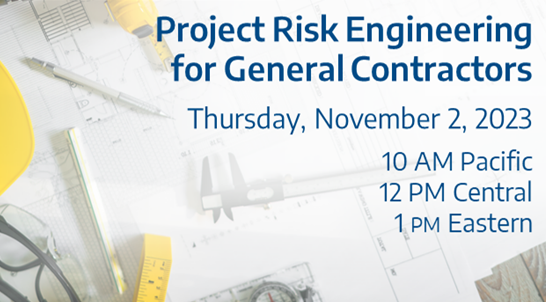

Free Webinar: Project Risk Engineering for General Contractors

Posted by & filed under Events.

Presented by:
Andrew Mendelson, FAIA, EVP, Chief Risk Management Officer, Berkley Design Professional
Timothy Brashear, P.E., Officer and VP, Construction Services, Rimkus

Thursday, November 2, 2023
10:00 a.m. to 11:00 a.m. Pacific Daylight Time
1.0 AIA Learning Units 
1.0 RCEP Professional Development Hour

This webinar has been recorded and is available on demand for Berkley Design Professional policyholders and our appointed agents and brokers on the BDP Risk® Learning Management System.

bdp Risk® lms login

This one-hour webinar was developed to provide participants with a working knowledge of the due diligence and risk engineering recommended practices for a robust and formal risk assessment, project selection, and risk transfer process for construction projects. 

A comprehensive risk engineering process is necessary to determine the bid, preconstruction, design development, construction, delivery, and warranty risks associated with a project and to enhance a contractor’s ability to achieve an on-time, in budget, fit for purpose, project delivery.

(more…)

The Benefits of Centralizing Your Claims and Risk Management Responsibilities

Posted by & filed under BDP Blog.

By Mark A. Froehlich
Assistant Vice President, Senior Claims Examiner
Berkley Alliance Managers, a Berkley Company

July 14, 2022

Centralizing claims and risk management responsibilities for architectural and engineering firms provides significant benefits. It saves time, reduces cost and improves outcomes.

Based on decades of managing complex architects and engineers professional liability claims, I recommend designating a specific individual as risk manager to supervise all claims and potential risk issues for your firm — regardless of the size of your firm.

I have worked with many architectural and engineering firms and I can confirm that having a designated risk manager in place is more efficient. Some firms establish a standalone risk manager role, while others assign risk management responsibilities to a firm leader.

Project managers are necessary to communicate details of specific project issues, but they are often too busy managing projects to also effectively manage claims. Alternatively, assigning this role to a firm leader or another designated person allows more efficient communication with brokers, insurers and attorneys.

(more…)
